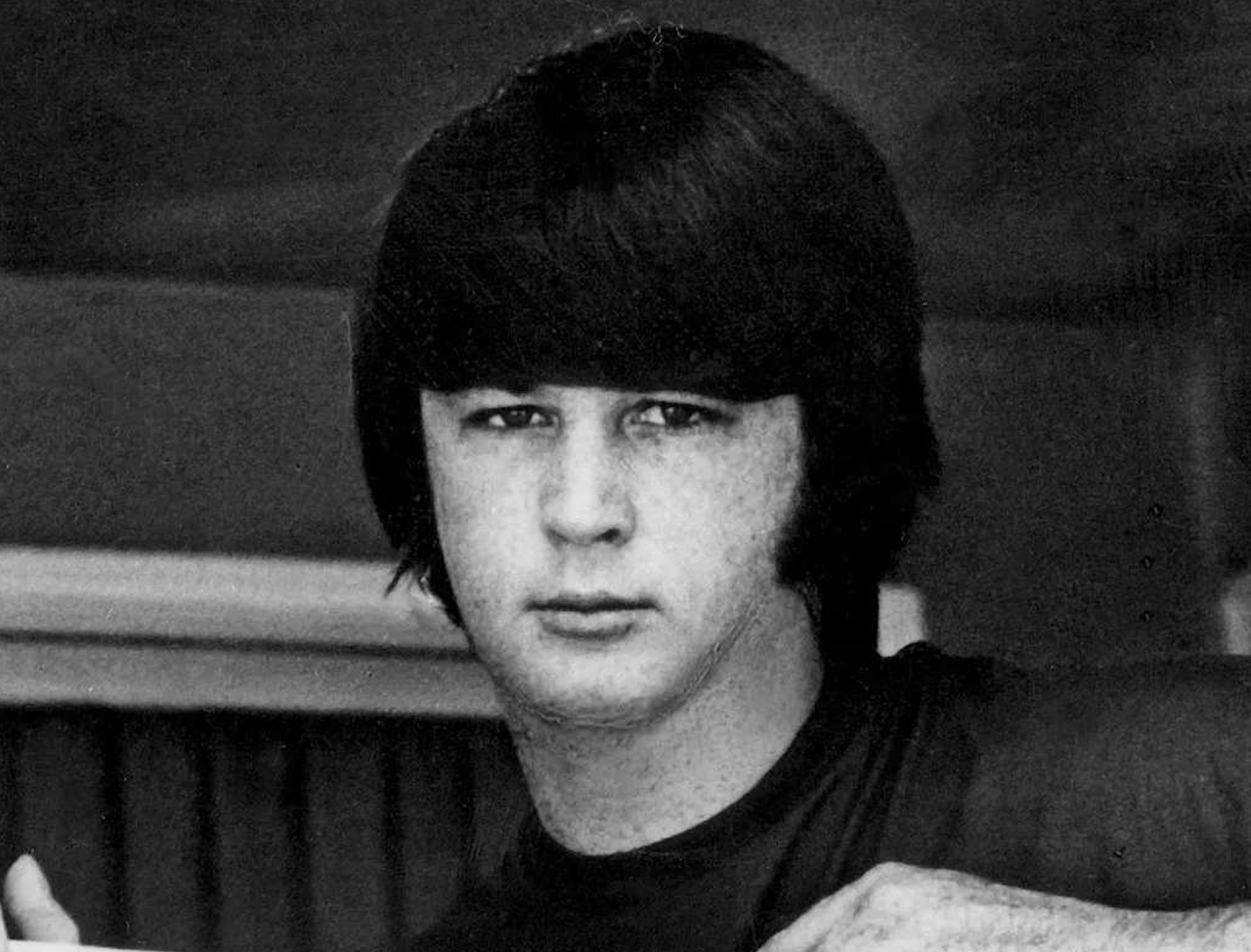
Brian Wilson, who passed this month at the age of 82, was one of the best songwriters and studio wizards of all time. Let’s dive into 10+ of his songs, and what specific aspects made them so great.
10. The nascent “wall of sound” production on “California Girls” (1965)
By 1965, Brian Wilson had fully grown his wings in the studio. He had already come to define the sound of Southern California, and was starting to give that sound more depth and nuance (before taking it even further the following year on Pet Sounds). Phil Spector’s dense “wall of sound” production for groups like The Ronettes and The Crystals was a major influence on Wilson, and you can hear elements of that method here — the echoing production, the thicket of saxophones, the chiming organ. The production is so cohesive and well done that it ultimately ends up being kind of subtle, allowing the great melody and harmonies to take center stage.
9. The bass harmony lines in “Little Deuce Coupe” (1963), “Catch a Wave” (1963), and “‘Til I Die” (1971)
I guess we technically have to share some of the props with Mike Love here, since he’s the one that sang all of these great bass lines. But Brian Wilson is the reason the vocal lines exist in the first place. The bass parts are not content to just hang out on the root note of the chord — they traverse up and down, moving around like a Paul McCartney bass guitar line. It’s so incredibly satisfying to sing along to those bass harmonies. (Bonus: Check out the a cappella version of “‘Til I Die” — the harmonies really shine.)
8. The rhythm and handclaps in the verses, and the harmonies in the chorus, of “I Get Around” (1964)
Does it get any more catchy than “I’m getting bugged driving up and down the same old strip. I gotta *CLAP* *CLAP* *CLAP* *CLAP*…”? I think not. And thank goodness for those handclaps, or we wouldn’t have been able to see Brian Wilson’s brother Dennis so eagerly (and cheesily) clap along in the video below. Go to 1:08 in the video and just look. I feel you, Dennis. If I had to pick one song from their surf/girls/fun era to take with me to a desert island, it would be “I Get Around.”
7. The evocative songwriting and intricate production on all of Pet Sounds, best exemplified by “I Know There’s An Answer” (1966)
Pet Sounds was the culmination of all of Brian Wilson’s desires. After hearing the lack of filler tracks on the Beatles’ Rubber Soul, he wanted to one-up the Fab Four and create the greatest rock album ever made. The complex symphonies in his head, the “wall of sound” production, the personal subject matter — on Pet Sounds, everything came into place. “I Know There’s An Answer” was originally conceptualized as “Let Go of Your Ego,” inspired by an acid trip Wilson took, but Mike Love didn’t want to be involved with such direct references to LSD, so the chorus and title were altered, but the message of introspection remained.
6. The vocal harmonies on “In My Room” (1963)
As early as 1963, while the Beach Boys were still very much in their surf music heyday, Brian Wilson was already writing introspective hymns of unparalleled beauty. The harmonies of “In My Room” are just stellar. The only group that can rival the Beach Boys when it comes to male vocal harmonies is Crosby, Stills & Nash, and this song almost demoralized David Crosby — “When I heard [‘In My Room’], I thought ‘I give up. I can’t do that. I’ll never be able to do that.'”
5. The vocal harmonies that define “Our Prayer” (2004)
“Our Prayer” is the beautiful opener to Wilson’s Smile album, which he originally felt too overwhelmed to finish with the Beach Boys in 1967 and finally re-recorded and officially released as a solo record in 2004. It’s a wordless blast of vocal harmonies, gorgeous enough for an echoing cathedral and powerful enough to level you like a truck. How one person can come up with the chords he’s singing here is beyond me.
4. The melody in “Don’t Worry Baby” (1964)
“Don’t Worry Baby” used to blend in with the pack of early Beach Boys hits in my mind, but over time, the transcendence of its melody started to stand out. That melody expertly conveys the mixture of melancholy and hopefulness in the lyrics. And as usual, the harmonies aren’t half bad either.
3. The piano chords and melody in the “Surf’s Up” demo (1966)
“Surf’s Up” wasn’t on the Beach Boys greatest hits CD I had as a kid, so it wasn’t until later in life that I became familiar with this understated tour de force. It would take more words than I can fit here to recount the winding road “Surf’s Up” took to be released, but to give you a sense, there are at least five different versions that could stake a claim as the “definitive” one. They all vary in both lead singer (Brian or Carl) and production level (full production suite or stripped down), but I came to especially love the early versions that involve Brian singing that sweeping melody over just a piano, playing the most beautiful chord sequence put to tape.
2. The melody and ending vocal interplay in “God Only Knows” (1966)
“God Only Knows” is a perfect song. Paul McCartney thinks it’s the greatest song of all time, and he might be right. And yet, I have it at only #2 here. That’s how good Brian Wilson was. The production on “God Only Knows,” replete with strings, flutes, a French horn, and innovative touches of percussion, would have been impressive enough, but that all takes a back seat because it features exquisite vocal harmonies, as well as one of the best melodies ever written (with a flawless lead vocal provided by Brian’s brother Carl). The last minute of the song, with its three soaring, contrapuntal vocal lines, is simply stunning. Oh, and by the way, I’m not much of a lyrics guy, but his and Tony Asher’s lyrics — the way they invoke God and frame the idea of love — were also groundbreaking for a pop song.
1. The production on “Good Vibrations” (1966)
Pop recording concepts that we now take for granted, like artist-driven studio experimentation, or production being integral to a song’s construction rather than just a means to an end, fully came to fruition when Brian Wilson successfully executed on his expansive vision for “Good Vibrations.” Here are the instruments used on “Good Vibrations”: piano, organ, harpsichord, guitar, electric bass, upright bass, cello, tambourine, shaker, drum kit, timpani, bongos, sleigh bells, piccolo, flute, tenor flute, contra-clarinet, bass saxophone, harmonica, bass harmonica, jaw harp, and, of course, the electro-theremin making that high-pitched “WEEE-OOOH-OOOH-OOOH.” And yet, somehow, Wilson’s production doesn’t feel overdone. No single instrument overwhelms or sticks out like a sore thumb. Every element has its place, every instrument coheres into a triumphant, surprising whole — even that wailing electro-theremin.
Bonus: To get a sense of what it was supposedly like in the studio with Brian Wilson at the helm, here’s a clip from the biopic Love & Mercy where Wilson — played by Paul Dano — obsesses over getting the cello players in “Good Vibrations” to play those triplets just right.
Bonus Bonus: One time on this very blog, I compared Brian Wilson to LeBron James and Pet Sounds to the 2016 Cleveland Cavaliers. To see how I got there, read The Golden State Warriors are the Beatles, in More Ways Than You Know.
 D-Brad Music